
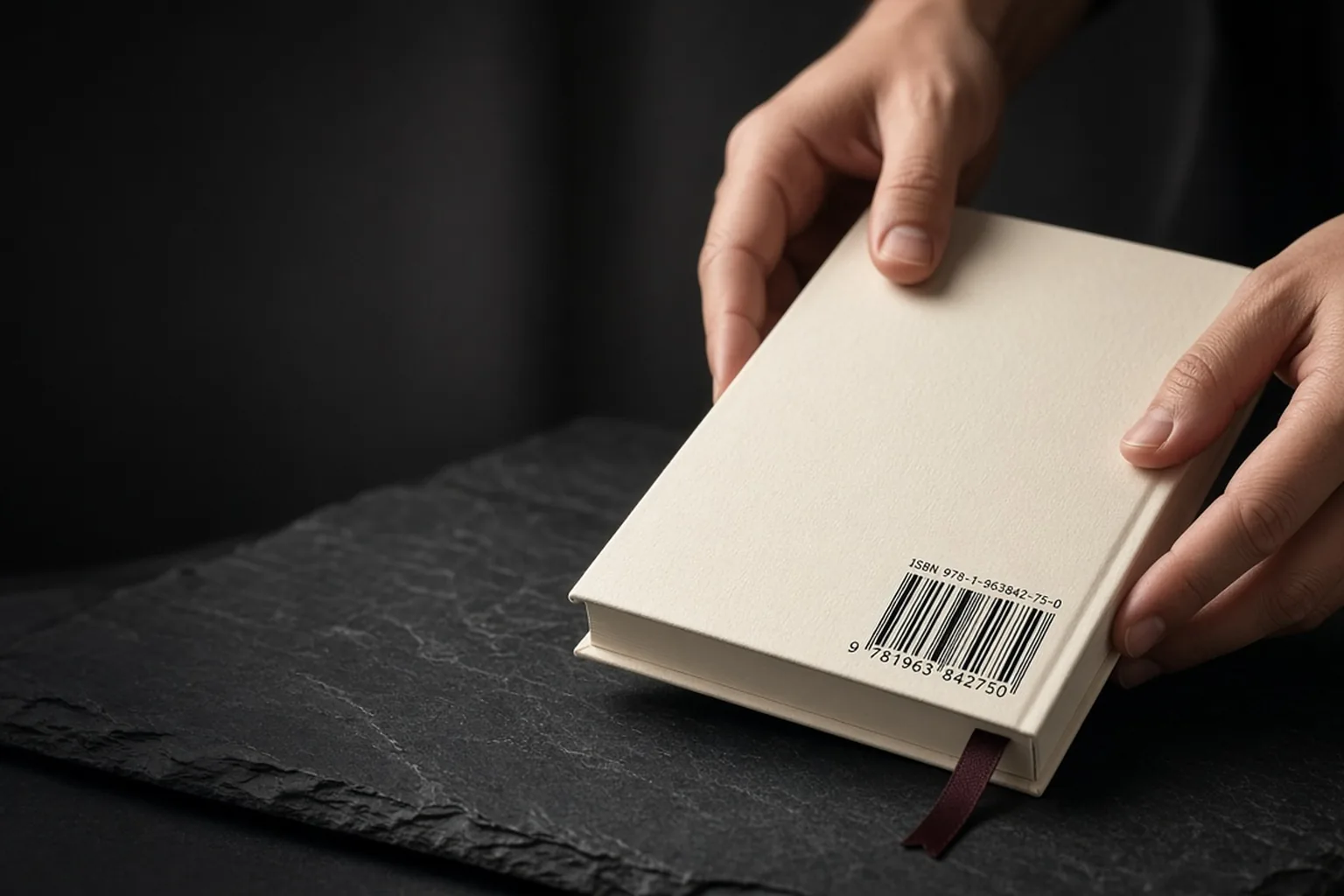
Who owns the ISBN when you self-publish is really a publisher-of-record question. The ISBN identifies a specific edition of a book and ties it to a publisher name in industry databases. If that publisher name is your imprint, you look like an independent publisher. If it is a platform’s free identifier, the platform often appears as publisher of record for that edition.
Author Vicinity helps authors set up stores while they remain publisher of record. On our assisted path, you keep the copyright and royalties. We are not a hybrid house taking your rights in exchange for a barcode.
Start with assisted publishing for production and listing. Writing and editing sit on ghostwriting and book editing.
What an ISBN actually identifies
An ISBN (International Standard Book Number) identifies a specific edition and format. Paperback, hardcover, and ebook typically each need their own ISBN. It is not a copyright registration by itself, and it is not a quality award. It is infrastructure for ordering, databases, and retail systems.
Copyright is a separate legal layer. ISBN ownership does not replace copyright ownership, and a free ISBN does not automatically transfer your copyright. Still, publisher-of-record optics matter when you want bookstores, libraries, or a durable imprint brand.
Bowker path: ISBN in your name (U.S.)
In the United States, Bowker is the official ISBN agency. When you purchase ISBNs through Bowker for your name or imprint, you control how that publisher name appears. That is the standard self-publishing posture for authors who want to look like a real imprint across Amazon, IngramSpark, and other channels.
Buy a block if you expect multiple formats. One ISBN per format keeps metadata clean. Authors who cheap out on a single free platform ISBN and later want wide distribution often rebuild listings under a new publisher name. That is avoidable friction.
Free KDP ISBN: Amazon as publisher of record
Amazon KDP offers a free ISBN option for paperbacks. It is convenient for Amazon-only experiments. The tradeoff: Amazon typically appears as the publisher of record for that edition. That can be fine for a test. It is a poor fit if you want your imprint everywhere, plan bookstore distribution, or care about consistent publisher branding.
You can still keep copyright on a free-ISBN edition. The issue is publisher field and future flexibility, not an automatic copyright seizure. Read the platform terms, then choose with eyes open.
Author Vicinity Listed path: 10-ISBN pack help
Our production ladder:
- Edit – $4,500 – copyediting and proofreading
- Print-ready – $7,500 – Edit plus cover and interiors; no store setup yet
- Listed – $9,500 (up to 70,000 words on list) – print-ready plus ISBN/copyright filing help and KDP + IngramSpark setup; you are publisher of record
Listed includes a 10-ISBN pack path so you are not stuck with a single free platform identifier when you want a real imprint footprint. Filing help is administrative support. It does not make Author Vicinity your publisher of record.
If your files are already print-ready and you only need Amazon setup, compare Amazon-only setup vs full store listing (Spark List $499 versus Listed $9,500). Build scopes in the custom package builder or request a quote.
ISBN vs copyright vs “who gets the royalties”
Keep three ideas separate:
- Copyright – who owns the creative work
- ISBN / publisher of record – whose imprint is attached to the edition in databases
- Royalties – who gets paid from sales under retailer and distributor accounts
At Author Vicinity, the service posture is consistent: you keep the copyright and royalties. Our job is files, metadata, and setup help, not capturing your intellectual property.
Common ISBN mistakes
- Reusing one ISBN across ebook and print formats
- Changing title, subtitle, or significant edition details without treating it as a new edition
- Starting on a free KDP ISBN, then wondering why bookstore setup looks inconsistent
- Letting a service company put its imprint on your ISBN while calling the deal “self-publishing”
- Buying ISBNs last, after covers and interiors are locked, then rushing metadata
If a contract puts someone else’s imprint on your book while you pay full freight, read it as a publishing deal, not as freelancers-for-hire.
Practical decision guide
- Amazon-only test with minimal brand needs – free KDP ISBN can be enough short-term
- Imprint you want to keep across stores – buy Bowker ISBNs in your name
- Want production + KDP + IngramSpark with ISBN help included – consider Listed $9,500
- Already have print-ready files and only need Amazon – consider Spark List $499
Related distribution context: KDP vs IngramSpark.
Putting ISBN ownership in perspective
Who owns the ISBN when you self-publish depends on who purchased and registered it. Own it via Bowker (or your agency) for imprint control. Treat free KDP ISBNs as Amazon-centric convenience. Author Vicinity’s Listed package ($9,500) includes a 10-ISBN pack path and store setup while you remain publisher of record. You keep the copyright and royalties.
Questions on imprint setup? See assisted publishing, call +1 (607) 303-5144, or email curvetsolutions@gmail.com. Alpharetta, GA.
How the 10-ISBN pack helps multi-format launches
A single ISBN is rarely enough once you plan paperback, ebook, and maybe hardcover. A 10-ISBN pack on the Listed path gives you room for formats and future editions without scrambling for one-off purchases mid-launch. Unused numbers stay with your imprint for the next title or edition. That is operational hygiene, not vanity.
Remember: assigning an ISBN does not replace copyright registration if you choose to register. It also does not create sales. It makes the edition trackable under your publisher name.
Bookstore and library optics (without overpromising)
IngramSpark-friendly files and an ISBN under your imprint improve the chance that bookstore and library channels can see you as a standard publisher entry. That is not a placement guarantee. It is table stakes for wide distribution conversations. Amazon-only free ISBNs can be enough for a pure KDP experiment. They are a weaker foundation if your twelve-month plan includes wide print distribution.
For channel mechanics, see KDP vs IngramSpark. For Amazon-only versus Listed scope, see Amazon-only setup vs full store listing.
Contract language to watch
If a service agreement says the company is “publisher,” claims exclusive rights, or puts its imprint on your ISBN while you pay production fees, pause. Assisted publishing at Author Vicinity is fee-for-service with you as publisher of record. Different companies use softer words for harder rights grabs. Read the imprint line and the rights section before you celebrate the barcode.
A mid-market author’s decision hour
Set a one-hour calendar block this week. Open your draft (or outline), your budget sheet, and any quotes you have collected. Write three lines only: what the book must do for the reader, what you can spend without resentment, and what must be true in ninety days for you to call the project successful. Those three lines prevent most expensive mistakes, because they stop you buying prestige language when you needed structure, or buying store setup when you needed pages.
Author Vicinity’s open menus exist for that hour. Writing sits at Sample $1,500, Short $10,000 (up to 25,000 words), Standard $24,000 (up to 60,000 words), and Full-length $36,000 (up to 90,000 words). Production sits at Edit $4,500, Print-ready $7,500, and Listed $9,500 (up to 70,000 words on list prices). Publishing setup sits at Spark List $499, Shelf Sync $899, Wide Circuit $2,799, and Global Press $4,200. On every path, you keep the copyright and royalties, and you stay publisher of record on a proper assisted setup.
Practical examples you can steal
Coach with a workshop transcript pile. Fund the Writing Sample ($1,500). If voice fits, move to Standard ($24,000). Freeze text. Buy Edit ($4,500). Decide later between Spark List ($499) and Listed ($9,500) based on whether IngramSpark matters yet.
Novelist with a fourth draft. Skip ghostwriting. Diagnose developmental need honestly. If structure holds, buy Edit ($4,500), then Print-ready ($7,500). Use Shelf Sync ($899) or Wide Circuit ($2,799) only when files and goals justify more storefronts.
Executive with a hard summit date. Say the date on the quote call. Prefer Short ($10,000) over fantasy Full-length compression. Do not announce a public sale date before outline approval. Quality compresses poorly; calendars that pretend otherwise create expensive rework.
Mistakes that look clever on day one
- Paying for wide listing while chapters still migrate weekly
- Buying proofreading to avoid a developmental conversation
- Accepting a “full package” price with no word cap and no rights sentence
- Using a free platform ISBN when imprint branding matters to your plan
- Treating ranking talk as a substitute for manuscript labor
Each mistake shares a pattern: buying the end of the pipeline before the middle is stable. Reverse that order and your spend becomes quieter and more effective.
Checklist you can reuse on any vendor call
- What exact deliverable do I leave with?
- What is the word band or page scope?
- How many revision rounds are included?
- Who owns copyright and who receives royalties?
- Whose retailer accounts and ISBNs are used?
- What is explicitly excluded (ads, PR, guarantees)?
- What happens if I pause or stop?
If answers are crisp, you can compare studios fairly. If answers are foggy, the fog is the product. Prefer fee-for-service partners who write scopes the way engineers write tickets: boring, specific, and finishable.
ISBN planning worksheet
- How many formats will you release in year one (ebook, paperback, hardcover)?
- Do you want your imprint name in industry databases?
- Will you need IngramSpark orderability for stores or libraries?
- Are you experimenting on Amazon only for ninety days?
- Who will pay the Bowker invoice and control the account?
If imprint control matters, buy identifiers in your name and avoid leaning on a free KDP ISBN as your long-term brand foundation. Listed ($9,500) includes a 10-ISBN pack path plus KDP and IngramSpark setup while you remain publisher of record. Spark List ($499) can still be right for Amazon-oriented launches when files are ready and imprint optics are a later project.
Copyright registration help (where scoped) is still not the same thing as an ISBN. Keep the layers separate in your notes so you do not expect a barcode to do a lawyer’s job.
Deeper comparison notes for careful buyers
Serious authors do not shop on vibes alone. They compare scope documents the way they would compare a construction bid: materials, labor, timeline, exclusions, and who holds the keys at the end. Apply that same discipline to writing, editing, and listing help.
When two quotes look similar on price and different on clarity, take the clearer one. Ambiguity is not a discount. Ambiguity is how unfinished manuscripts, contested rights, and orphaned retailer accounts happen. Author Vicinity’s published ladders exist so you can map a project without decoding a fog machine.
- Writing: Sample $1,500 · Short $10,000 · Standard $24,000 · Full-length $36,000
- Production: Edit $4,500 · Print-ready $7,500 · Listed $9,500 (up to 70,000 words on list prices)
- Publishing: Spark List $499 · Shelf Sync $899 · Wide Circuit $2,799 · Global Press $4,200
Those numbers are not a dare to buy everything. They are a map. Buy the next mile you need. Keep ownership language boring and explicit: you keep the copyright and royalties.
Field notes from first-time publisher of record projects
Authors who finish cleanly usually share habits. They answer interview requests on time. They freeze titles and subtitles before final covers. They refuse to argue with a proofread while still rewriting chapter four. They treat retailer dashboards as business infrastructure, not as a mystery left to a salesperson forever.
Authors who struggle usually share the opposite habits. They change the thesis after layout. They buy ads for a draft that is still soft. They accept “we’ll handle everything” without asking whose login is used. None of those patterns require bad intentions. They only require a missing process.
If you want a partner for the process without surrendering publisher status, start from the service pages that match your bottleneck: ghostwriting, book editing, or assisted publishing. Mix pieces in the custom package builder when your project is not a single ladder rung.
One-page brief you can paste into any quote request
- Genre and primary reader
- Current word count and draft status
- Whether you need writing, developmental help, copyediting and proofreading, design, and/or store setup
- Hard dates (and which ones are real)
- ISBN / imprint preferences
- Must-have ownership terms (copyright, royalties, publisher of record)
- Budget band you can fund without resentment
Send that brief to Author Vicinity via contact, or to any other vendor you trust enough to evaluate. Clear inputs create clear scopes. Clear scopes create finishable books.
Final buyer notes before you spend
If you remember only one operating principle from this article, make it sequencing. Buy writing when pages do not exist. Buy developmental thinking when the shape is wrong. Buy copyediting and proofreading when the shape is right. Buy design when the words are frozen. Buy store setup when the files are real. Author Vicinity prices those stages openly so you can fund the next correct step instead of an anxious bundle.
Writing Sample $1,500 (is credited toward a full writing package if you continue). Short $10,000. Standard $24,000. Full-length $36,000. Edit $4,500. Print-ready $7,500. Listed $9,500 (up to 70,000 words on list prices). Spark List $499. Shelf Sync $899. Wide Circuit $2,799. Global Press $4,200. Fee-for-service. You remain publisher of record on assisted setup. You keep the copyright and royalties.
When you are ready for a scoped next step, use contact, or begin on ghostwriting, book editing, or assisted publishing.
FAQ
Who owns the ISBN when you self-publish?
Ownership follows who purchased and registered it. If you buy through Bowker (or your country’s agency) in your name or imprint, you control that identifier. A free KDP ISBN typically lists Amazon as publisher of record for that edition.
Why should I own my ISBN instead of using a free platform ISBN?
Owning your ISBN keeps your imprint as publisher of record, which matters for bookstore paths, brand consistency, and moving editions without looking like a different publisher. At Author Vicinity, you keep the copyright and royalties on service engagements.
Does Author Vicinity’s Listed package include ISBNs?
Yes. Listed at $9,500 (up to 70,000 words) includes print-ready files plus ISBN/copyright filing help and KDP + IngramSpark setup, including a 10-ISBN pack path so you remain publisher of record. At Author Vicinity, you keep the copyright and royalties on service engagements.
Can I use the same ISBN on ebook and paperback?
No. Each format generally needs its own ISBN. Plan a small block if you will release paperback, hardcover, and ebook editions. At Author Vicinity, you keep the copyright and royalties on service engagements.
Do I keep the copyright and royalties when Author Vicinity helps with ISBN setup?
Yes. At Author Vicinity, you keep the copyright and royalties. ISBN help is administrative support; you stay author and publisher of record on our assisted path. Compare deliverables, ownership language, and exclusions before you choose a vendor.